
Parliament Sessions Hall
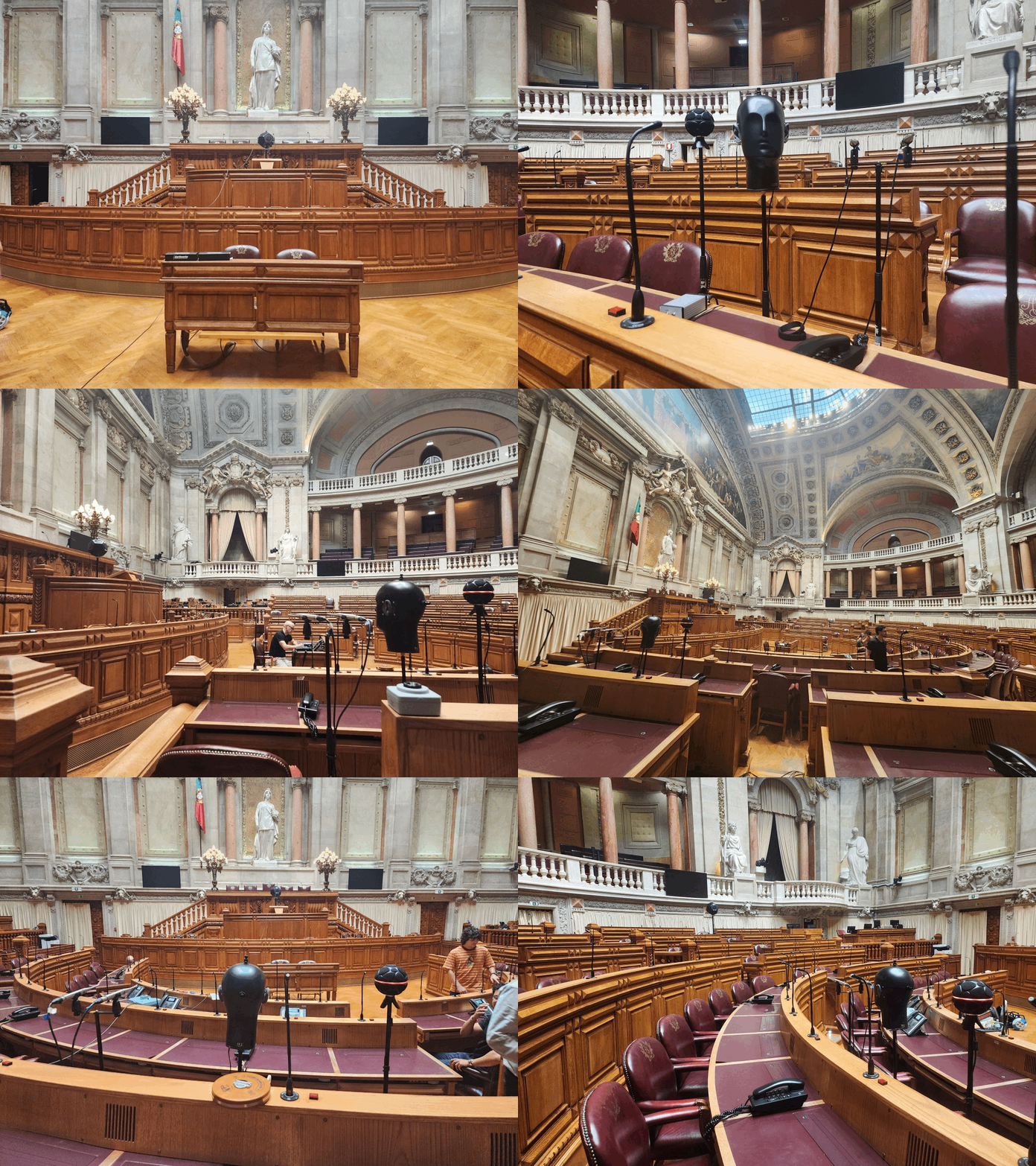
Above the Presidential tribune stands a large lunette painted by Veloso Salgado, representing the Constituent Courts of 1821 – which drafted the Constitution of 1822, the first in Portuguese constitutional history – gathered in the Library of the Convent of Necessidades in Lisbon. This large semicircular canvas is framed by coats of arms with the arms of the districts and the former overseas provinces, evocative of the constituencies from which the deputies were elected, painted by Benvindo Ceia.
The three ceiling paintings, distributed around the large skylight, were executed by Alves Cardoso and represent allegories of Science, Arts and Industry; the Fatherland, Peace and Fortune; Commerce and Agriculture.
On the balcony of the central gallery on the top floor, a monumental stone clock stands out. Refurbished in 1990, it features an electromechanical mechanism with a quartz control system from the German manufacturers Bürk and Kienzle.
The galleries on the first floor, intended for the public, are punctuated by six plaster statues, identified by inscriptions on their respective plinths: the Constitution, the Law, Jurisprudence, Eloquence, Justice, and Diplomacy—allegorical symbols linked to the art of legislating and the exercise of power. The total capacity of the galleries is 660 seats.
The internal area of the Sessions Hall is approximately 780 m2, with an average ceiling height of approximately 16 m, its volume is approximately 12910 m3.
Main Materials: mixed masonry, marble, wood, painted stucco, glass, fabric.
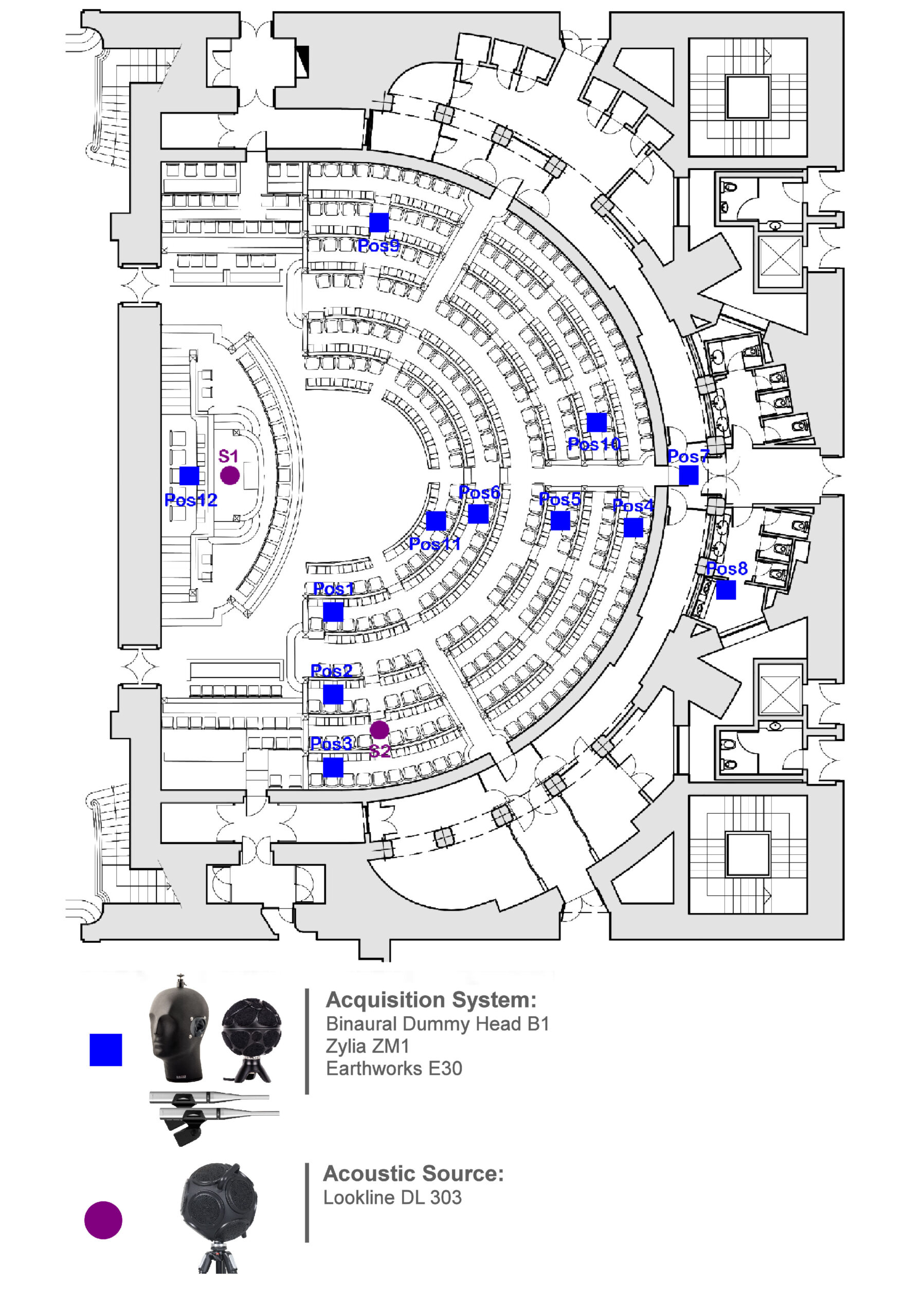
Measurement points and source location
The sound source was located in two positions inside the Sessions Hall: in the speaker’s pulpit (S1) and in the 5th row of the benches of the right wing (S2). Twelve measurement points (Pos1 – Pos8 for S1; Pos9 – Pos12 for S2) were chosen inside the hall in carefully chosen locations so to cover several benches and the president’s tribune.
 Português